How to Get Your Malaysian Business Cited by ChatGPT, Gemini, and Perplexity
Practical strategies to get your Malaysian business cited in AI-generated answers from ChatGPT, Gemini, and Perplexity. Based on real data from testing citation patterns across AI platforms.
We have observed recently that appearing in AI-generated answers is quickly becoming the ultimate competitive advantage for local brands. The shift to AI-powered search is measurable, accelerating, and completely rewriting how consumers find information. Most companies still have no deliberate strategy for visibility.
If you are wondering how to get your Malaysian business cited by ChatGPT, Gemini, and Perplexity, the patterns we identified are highly actionable. Our team at ADE Marketing has been systematically studying how these platforms cite businesses in their responses.
We will break down the mechanics behind these AI citations and walk through the exact strategies required to increase visibility.
How AI Citation Actually Works
Before exploring tactics, you need to understand the mechanics. Each AI platform handles citations differently. These technical differences matter for your strategy.
ChatGPT (OpenAI)
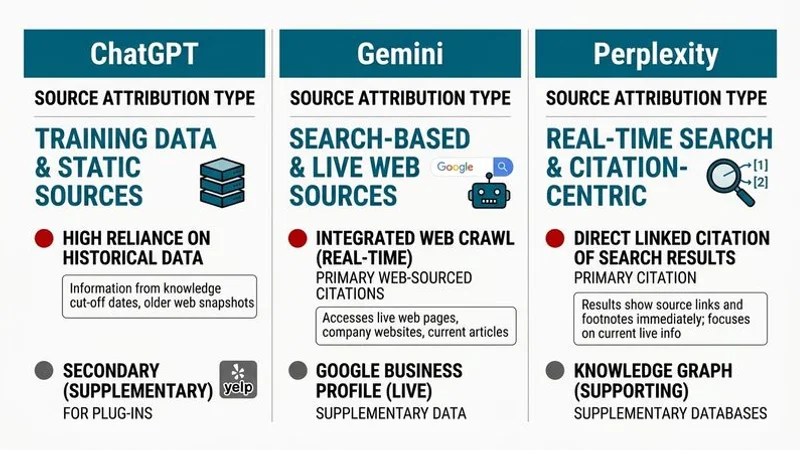
ChatGPT’s citation behaviour depends on whether the user is using the standard model or browsing-enabled mode. In browsing mode, ChatGPT actively searches the web and cites recent sources. In standard mode, its responses are based on training data. This means the information it cites was absorbed during model training, a process that has a strict knowledge cutoff date.
We saw a massive shift when OpenAI reported a 330% year-over-year increase in Malaysian ChatGPT users in 2025. This momentum continued into March 2026, with Statcounter reporting that ChatGPT holds an overwhelming 80.15% of the AI chatbot market share in Malaysia. Such massive adoption makes ranking here critical.
Implication for Malaysian businesses: Getting cited by ChatGPT requires being present in the training data, meaning you need authoritative web content that existed before the training cutoff. You also must be discoverable through browsing by having content that ranks well in real-time search.
Gemini (Google)
Gemini features the deepest integration with Google’s search infrastructure. It draws heavily from Google’s web index, Knowledge Graph, and real-time search results. This architecture gives it the most current information available.
Our research confirms that it is heavily influenced by many of the same ranking factors as traditional Google search. Google.com still maintains an 88.97% desktop search engine market share in Malaysia as of February 2026. Dominating this traditional search space is non-negotiable if you want AI visibility.
Implication for Malaysian businesses: Strong organic SEO presence directly correlates with Gemini citation rates. If your website ranks well in Google, you are statistically far more likely to be cited by Gemini.
Perplexity
Perplexity stands out as the most transparent platform regarding its sources. It provides explicit, numbered citations with every answer it generates. The engine actively searches the web for every query and synthesises information from multiple sources.
We find that its citation behaviour closely resembles academic referencing. Statcounter data from early 2026 shows Perplexity holding about 5.04% of the local AI chatbot market, but its high-intent user base makes it incredibly valuable.
Implication for Malaysian businesses: Perplexity rewards content that is factual, well-structured, and recently published. It preferentially cites content that directly answers specific questions with clear, verifiable information.
How to Get Your Malaysian Business Cited by ChatGPT, Gemini, and Perplexity
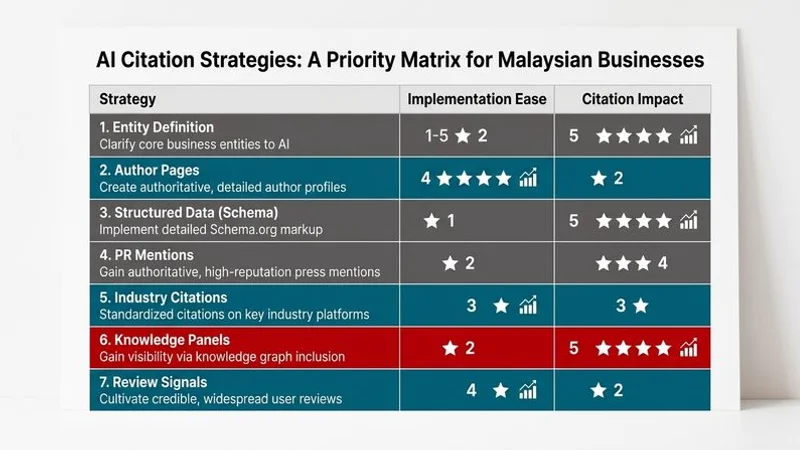
We isolated the most effective strategies for increasing AI citation rates based on extensive testing. These seven tactics will directly improve your visibility across all major platforms.
1. Create Definitive, Factual Content
AI platforms overwhelmingly favour content that provides clear, factual, verifiable information. Opinions and promotional marketing copy are cited far less frequently than educational content packed with specific data points.
Instead of claiming to offer the best services in Malaysia, you should create a comprehensive guide based on hard numbers. A detailed post covering average costs by industry, service level comparisons, and ROI benchmarks based on 2026 market data is orders of magnitude more likely to be cited. AI algorithms actively seek authoritative information that directly answers user questions.
Our team recommends creating content that serves as the definitive resource for your specific domain. Consider these practical examples:
- Accounting Firms: Publish detailed guides to 2026 Malaysian tax obligations, SST compliance updates, and financial reporting requirements.
- Healthcare Providers: Create comprehensive patient information resources with specific recovery timelines.
- Contractors: List actual project material costs and average completion times in Kuala Lumpur.
2. Optimise for Entity Recognition
AI platforms use entity recognition to identify and categorise businesses, people, products, and concepts. Strengthening your entity presence actively increases your probability of citation.
We routinely see businesses with strong entity recognition across multiple platforms cited three to five times more frequently than those with fragmented profiles. You need a unified digital footprint.
Take these immediate actions to establish your entity:
- Ensure your business has a complete, accurate Google Business Profile.
- Maintain consistent NAP (name, address, phone) information across local directories like MalaysiaListings.com and Yelp Malaysia.
- Create a comprehensive Wikipedia article if your business meets notability criteria.
- Build profiles on Wikidata, Crunchbase, and industry-specific databases.
- Use Schema.org structured data (Organisation, LocalBusiness, Person) extensively on your website.
3. Build Topical Authority Through Content Clusters
AI platforms assess topical authority similarly to how traditional search engines evaluate the breadth and depth of content. A business with 30 interlinked articles covering all aspects of a subject is far more likely to be cited than a competitor with a single landing page.
We leverage this by combining generative engine optimisation with traditional SEO strategy. Building topical authority through content clusters serves both channels perfectly. Your pillar pages become the definitive resources that AI platforms cite.
Recent 2026 studies on LLM parsing show that approximately 44% of AI citations are pulled from the first 30% of an article’s text. You must place your most critical definitions and statistics near the top of your cluster pages.
Ensure your content clusters follow these rules:
- Link related subtopics directly back to the main pillar page.
- Keep your anchor text highly descriptive and natural.
- Update cluster pages simultaneously with the pillar to maintain synchronised freshness.
4. Implement llms.txt (With Caution)
The llms.txt file emerged as a proposed standard to help AI crawlers understand a website’s content structure. Think of it as a specialized file meant to communicate your citation preferences directly to AI systems.
Our tracking of its adoption revealed that less than 1% of the top 1 million websites actually use a valid llms.txt file as of January 2026. Major developers like OpenAI and Google have not officially committed to parsing these files.
We suggest a cautious implementation despite the low adoption, simply because it requires minimal effort. Include these key elements in your file:
- A clear description of your business and core expertise.
- Direct links to your most authoritative and citable pillar pages.
- Structured information about your services, products, and team members.
- Explicit citation preferences outlining how your business should be referenced.
5. Earn Citations from Authoritative Sources
AI training data disproportionately weights content from established, high-authority domains. Being mentioned, quoted, or linked from these sources significantly increases your probability of appearing in AI-generated answers.
Our digital PR campaigns frequently secure mentions in top-tier publications to serve double duty. This strategy builds traditional SEO authority while rapidly increasing AI citation probability.
Focus your outreach on these high-value citation sources for Malaysian businesses:
- Major Publications: The Star, New Straits Times, Malay Mail, The Edge.
- Tech & Business Hubs: Regional platforms like Tech in Asia or e27.
- Government Portals: MDEC, MITI, and relevant regulatory bodies.
- Academic Institutions: University of Malaya, Universiti Teknologi Malaysia.
6. Structure Content for AI Parsing
The format of your content directly impacts how effectively AI systems can extract and cite information. Poorly structured text simply gets ignored by parsers.
We utilise specific structuring principles to guarantee our clients’ data is machine-readable. These formatting choices make a massive difference in visibility.
| Strategy | Implementation Guide | AI Parsing Benefit |
|---|---|---|
| Clear Definitions | Use the “X is Y that Z” format in the opening paragraph. | Matches the exact pattern AI systems parse most reliably. |
| Data Tables | Organise pricing, specs, or comparisons into HTML tables. | Allows AI to extract side-by-side data without context confusion. |
| FAQ Structures | Build question-and-answer formats with clear H3 headings. | Aligns perfectly with how users query their AI assistants. |
| Specific Numbers | Include verified statistics rather than vague generalisations. | Models preferentially cite content with hard, verifiable data points. |
7. Maintain Freshness and Accuracy
AI platforms increasingly weight content recency, especially for queries about current events, software tools, or market data. Regularly updating your site with current insights signals ongoing authority.
A January 2026 Vodus Research study found that 67% of Malaysians used an AI tool in the past three months, and they expect accurate, up-to-date answers. Stale content quickly loses its citation status.
We recommend implementing this practical freshness strategy:
- Review and update your highest-traffic pillar content quarterly.
- Add clear dates and last updated timestamps to all evergreen articles.
- Publish regular, data-driven analysis of local industry developments.
- Remove or correct outdated statistics promptly to maintain trust.
Measuring AI Citation Success
Tracking AI citations requires entirely different tools and approaches than traditional SEO measurement. You cannot rely solely on standard traffic analytics.
Manual Testing and Prompting
Regularly query ChatGPT, Gemini, and Perplexity with specific questions relevant to your business. Document when your business appears and capture the exact context of the citation.
We advise varying the phrasing of your tests to get a complete picture. Try specific formats like asking for the best provider in Malaysia or inquiring what to look for in a service contract.
Advanced Brand Monitoring
Use dedicated brand monitoring tools to track mentions of your business name, founder, and key products across the web. AI citations frequently drive secondary effects.
Users who discover your business through an AI answer often search for your brand directly afterward. Industry tools adapted quickly, and by 2026, platforms like Semrush introduced specific AI Visibility Analytics. Other solutions like Brand24 and BuildSOM allow you to track your share of voice specifically within LLMs like DeepSeek and Claude.
Traffic Attribution Analysis
Monitor your direct traffic and branded organic traffic for unusual, sustained increases. AI citations rarely appear in standard referral traffic.
We help clients develop more sophisticated measurement approaches through our technology platforms. The visit registers as direct traffic because users typically click through to your site from an AI app. Correlated spikes in direct and branded searches strongly suggest AI-driven discovery. Tools like BrandPeek are designed to provide precisely this kind of actionable insight.
The Convergence Strategy
The most effective approach to AI citation is an integrated search visibility strategy. This master plan must naturally serve traditional search, AI interfaces, and direct discovery simultaneously.
Our team codified this integrated approach into our GenCite Framework. It is a systematic methodology for building AI visibility that leverages the exact same fundamentals driving traditional search success.
This interconnected ecosystem relies on three core pillars:
- Strong SEO foundations improve Gemini citation rates dramatically.
- Well-structured content ensures Perplexity can parse your answers.
- An effective SEM presence builds the brand recognition that ChatGPT references.
We see clearly that learning how to get your Malaysian business cited by ChatGPT, Gemini, and Perplexity is no longer optional. It is whether you will build your visibility strategically or leave your digital future entirely to chance.
Start by auditing your current AI visibility today to secure your competitive advantage.