How to Get Your Business Cited by ChatGPT, Gemini & Perplexity
Proven strategies to get your Malaysian business cited in AI-generated answers from ChatGPT, Gemini, and Perplexity. Learn exactly how AI citation works and what drives visibility in 2026.
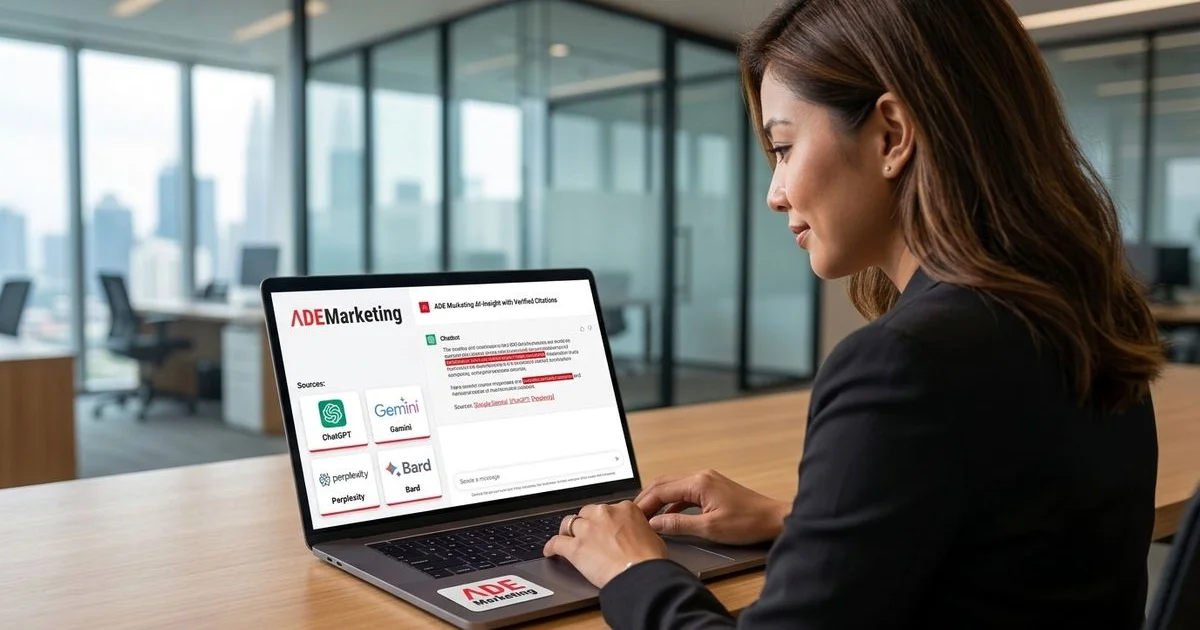
The way Malaysian consumers discover local businesses is fundamentally changing. AI-powered search tools like ChatGPT, Gemini, and Perplexity are rapidly becoming the first stop for people researching products, services, and professional expertise. If your business is not positioned to be cited in these AI-generated answers, you are invisible to a rapidly growing segment of your market.
This guide from ADE Marketing covers exactly how to get your business cited by the leading AI platforms, with strategies specifically optimised for the Malaysian market.
Why AI Citations Matter for Malaysian Businesses in 2026
The numbers tell a clear story. OpenAI reported a 330% year-over-year increase in Malaysian ChatGPT users during 2025. By early 2026, Statcounter data shows ChatGPT dominates the AI chatbot market in Malaysia with approximately 80.15% share, while Google Gemini holds around 10%, and Perplexity captures about 5.04% of users.
What makes this critical for business owners is the behaviour shift these platforms create. When a potential customer asks Perplexity “best SEO company in Kuala Lumpur” or Gemini “recommended accounting firm Petaling Jaya,” the AI synthesises an answer from sources it has been trained on or can access in real-time. If your business is not present in those sources, you simply do not appear in the conversation.
This is not futuristic speculation. It is the current reality of how discovery is happening in Malaysia right now.
How AI Citation Actually Works on Each Platform
Understanding the technical mechanics behind AI citations is essential before you can strategically optimise for them. Each platform operates differently.
ChatGPT: Training Data and Real-Time Browsing
ChatGPT citations come from two distinct modes. In standard mode, responses draw exclusively from training data with a fixed knowledge cutoff date. In browsing-enabled mode, ChatGPT actively searches the web and cites sources in real time.
For Malaysian businesses, this creates a dual strategy. You must establish authoritative web presence that existing training data can absorb, while simultaneously creating content that ranks well enough to be discovered through real-time browsing. Both paths lead to citations.
Gemini: Deep Google Integration
Gemini has the deepest integration with conventional search infrastructure of any major AI platform. It draws from Google’s web index, Knowledge Graph, and real-time search results. This architecture means Gemini citations correlate strongly with traditional Google ranking factors.
In Malaysia, Google holds 88.97% of desktop search engine market share as of February 2026. The implication is direct: strong organic SEO performance in Google directly translates to higher Gemini citation probability. These are not separate strategies. They are the same strategy viewed from different angles.
Perplexity: Academic-Style Source Transparency
Perplexity differentiates itself through citation transparency. Every answer includes numbered citations linked directly to source material. The platform actively searches the web for every query and synthesises information from multiple authoritative sources.
Perplexity rewards content that is factually precise, well-structured, and recently published. Its citation behaviour closely resembles academic referencing. For Malaysian businesses targeting high-intent customers who value detailed, sourced information, Perplexity optimisation should be a priority.
7 Strategies to Get Your Malaysian Business Cited by AI Platforms
Based on systematic testing and analysis of citation patterns across these platforms, we have identified seven tactics that consistently improve AI visibility for businesses in Malaysia.
1. Create Definitive, Factual Content That AI Can Verify
AI platforms preferentially cite content that provides clear, factual, and verifiable information. Promotional marketing copy rarely gets cited. Educational content with specific data points gets cited far more frequently.
Instead of generic claims about offering the best services, create comprehensive guides built on hard numbers. A detailed post covering average service costs in Kuala Lumpur, comparisons between service levels, and ROI benchmarks based on 2026 market data is dramatically more likely to be cited than advertising language.
The key is becoming the authoritative source that AI algorithms actively seek when generating responses. Consider these industry-specific examples for Malaysian businesses:
- Accounting firms: Publish definitive guides to 2026 Malaysian tax obligations, SST compliance updates, and Companies Act 2016 financial reporting requirements.
- Healthcare providers: Create patient information resources with specific treatment timelines, costs, and recovery protocols.
- Property agents: Produce data-driven market reports with actual transaction volumes in Kuala Lumpur, Selangor, and Penang.
- Legal practices: Develop explainers of Malaysian law that directly answer common client questions about contracts, employment law, and business registration.
2. Optimise for Entity Recognition Across All Platforms
AI systems use entity recognition to identify and categorise businesses, people, products, and concepts. A unified, consistent digital entity presence dramatically increases citation frequency.
Our observations show businesses with strong entity recognition across multiple platforms get cited three to five times more frequently than those with fragmented, inconsistent profiles.
To strengthen your entity presence, take these immediate actions:
- Complete and verify your Google Business Profile with accurate NAP information, business categories, photos, and regular posts.
- Ensure consistent NAP (name, address, phone) across Malaysian directories including MalaysiaListings.com, Yelp Malaysia, and Foursquare.
- Create or improve your Wikipedia article if your business meets notability criteria.
- Build profiles on Wikidata, Crunchbase, and industry-specific databases relevant to your sector.
- Implement comprehensive Schema.org structured data on your website, including Organisation, LocalBusiness, and Person schemas where appropriate.
3. Build Topical Authority Through Interlinked Content Clusters
AI platforms evaluate topical authority similarly to how traditional search engines assess content breadth and depth. A business with 20 to 30 interlinked articles covering all aspects of a subject is far more likely to be cited than a competitor with a single landing page and no supporting content.
The strategic approach is to combine GEO with traditional SEO through content clustering. Your pillar pages become the authoritative resources that AI platforms cite, while cluster content supports and reinforces that authority.
Recent research on LLM parsing indicates approximately 44% of AI citations are drawn from the first 30% of an article’s text. This means you must place critical definitions, statistics, and key information near the beginning of your content.
Structure your content clusters with these principles:
- Link all related subtopic articles directly back to the main pillar page using descriptive anchor text.
- Ensure pillar pages open with clear definitions that match how users naturally phrase questions.
- Update cluster content simultaneously with pillar pages to maintain topical freshness.
- Interlink cluster articles bidirectionally to distribute authority throughout the cluster.
4. Publish Consistent Data-Driven Industry Analysis
AI platforms are fundamentally statistical systems. They preferentially cite content containing hard numbers, specific dates, and verifiable statistics over vague generalisations or qualitative claims.
For Malaysian businesses, this creates a significant opportunity. Publish regular industry analysis containing actual data points that AI systems can cite. The more specific and verifiable your numbers, the more likely they become citation targets.
Practical examples for Kuala Lumpur businesses:
- Property management companies: Publish monthly rental yield data for specific locations like Mont Kiara, Bangsar, or Petaling Jaya.
- Digital marketing agencies: Share case study results with specific conversion percentages, cost-per-lead figures, and timeline benchmarks.
- F&B businesses: Release seasonal menu cost analysis based on actual supplier pricing.
- Recruitment agencies: Publish salary surveys with specific ranges by role, experience level, and industry sector.
5. Earn Mentions from Authoritative Malaysian Sources
AI training data disproportionately weights content from established, authoritative domains. Being mentioned, quoted, or linked from credible publications significantly increases your probability of appearing in AI-generated answers.
This is digital PR working double duty. Every mention in an authoritative publication builds traditional SEO signals while simultaneously increasing AI citation probability.
Prioritise outreach to these high-value citation sources for Malaysian businesses:
- Major publications: The Star, New Straits Times, Malay Mail, The Edge Malaysia.
- Business and tech hubs: Tech in Asia, e27, Business Today Malaysia.
- Government portals: MDEC, MITI, SME Corp Malaysia, and relevant regulatory bodies.
- Academic institutions: University of Malaya, Universiti Teknologi Malaysia, Taylor’s University.
6. Structure Content for Machine Readability and AI Parsing
The format of your content directly determines how effectively AI systems can extract and cite information. Poorly structured text gets ignored by AI parsers. Well-structured content gets selected.
Implement these formatting strategies to maximise AI readability:
| Element | Implementation | Why AI Cites It |
|---|---|---|
| Opening definitions | Use “X is Y that Z” format in first paragraph | Matches exact parsing patterns AI systems use |
| Data tables | Present pricing, specifications, and comparisons in HTML tables | Allows side-by-side data extraction without context confusion |
| FAQ sections | Structure Q&A with clear H3 headings matching common queries | Aligns with how users naturally ask AI assistants |
| Specific numbers | Include verified statistics rather than vague descriptors | Models preferentially cite hard, verifiable data |
| Citations | Link to authoritative sources within your content | Signals trustworthiness and authority |
7. Maintain Content Freshness and Update Actively
AI platforms increasingly weight content recency, particularly for queries about current market conditions, regulatory changes, or industry developments. Malaysian businesses operating in rapidly evolving sectors must prioritise content freshness.
We recommend implementing a structured content refresh process:
- Review and update your highest-traffic pillar content every quarter.
- Add clear publication dates and “last updated” timestamps to all evergreen articles.
- Publish regular data-driven analysis of local industry developments and market shifts.
- Correct or remove outdated statistics promptly to maintain trust signals.
Measuring Your AI Citation Success
Tracking AI citations requires different tools than traditional SEO measurement. Standard analytics do not capture how your business appears in AI-generated answers.
Systematic Prompt Testing
Query ChatGPT, Gemini, and Perplexity regularly with questions directly relevant to your industry and location. Document when your business appears and capture the complete citation context.
Test multiple phrasings of the same core question. Ask both broad queries (“best digital marketing agency Kuala Lumpur”) and specific ones (“SEO company Solaris Dutamas nearby”). Different phrasing surfaces different citation patterns.
Brand Monitoring for AI Discovery
Monitor your direct traffic and branded search volume for unusual sustained increases. AI citations frequently drive secondary discovery effects. Users who encounter your business in an AI answer often then search for your brand directly.
By 2026, platforms like Semrush introduced specific AI Visibility Analytics features. Brand24 and similar tools now offer share-of-voice tracking specifically within LLM responses. These tools provide ongoing visibility into how often and in what context your brand appears in AI-generated content.
Referral and Direct Traffic Correlation
AI citations rarely appear as “Perplexity” or “ChatGPT” in standard referral reports. Users typically click through from the AI application directly to your website, which registers as direct traffic. Correlated spikes in direct traffic and branded searches strongly indicate AI-driven discovery is occurring.
Integrating AI Citation Strategy With Your Overall Search Presence
The most effective approach combines traditional SEO, GEO, and brand building into a unified strategy. These disciplines are not separate budget items. They reinforce each other when properly integrated.
Our GenCite Framework codifies this integrated approach. It builds AI visibility while leveraging the exact same fundamentals that drive traditional search success. The interconnected ecosystem relies on three reinforcing pillars:
- Strong SEO foundations improve Gemini citation rates because Gemini draws directly from Google’s ranking systems.
- Well-structured, factual content ensures Perplexity can parse and cite your information when generating answers.
- Consistent SEM presence builds the brand recognition that ChatGPT references in its training-data-based responses.
Getting Started With Your AI Citation Strategy Today
The shift to AI-powered search is measurable, accelerating, and rewriting how Malaysian consumers discover local businesses. Most companies still have no deliberate strategy for AI visibility. This represents a significant competitive opportunity for business owners who act now.
Start with a clear audit of your current AI discoverability. Test how your business appears across ChatGPT, Gemini, and Perplexity with questions relevant to your industry. Identify gaps in your factual content presence, entity consistency, and topical authority. Then systematically address each gap.
The businesses positioning themselves strategically in this space today will hold durable advantages as AI adoption continues accelerating in Malaysia through 2026 and beyond.
For more guidance on building comprehensive search visibility that includes AI platforms, explore our SEO services or generative engine optimisation capabilities.