The Cost of Google Ads in Malaysia: 2026 SEM ROI Guide
A detailed breakdown of Google Ads costs in Malaysia for 2026. Covers average CPCs by industry, budget planning strategies, and how to maximise ROI from your SEM investment.
As the digital landscape shifts, you are likely reviewing The Cost of Google Ads in Malaysia: 2026 SEM ROI Guide strategies because rising click costs make careless spending dangerous. Malaysian search engine market share remains firmly in Google’s grip at nearly 98.88 percent. We often see businesses throwing money at broad match terms without tracking the actual return.
The reality is that the gap between a sharp, data-driven strategy and a poorly monitored account represents thousands of wasted ringgit.
Managing SEM campaigns for companies across the country has taught our team exactly where the financial leaks happen.
Most businesses do not realise that new AI Overviews are shrinking ad real estate and driving up auction prices. Our experts will break down the hard data behind current industry pricing. Then, we can explore the exact factors inflating your bills and the specific tactics required to protect your profit margins.
Average Cost-Per-Click and The Cost of Google Ads in Malaysia: 2026 SEM ROI Guide
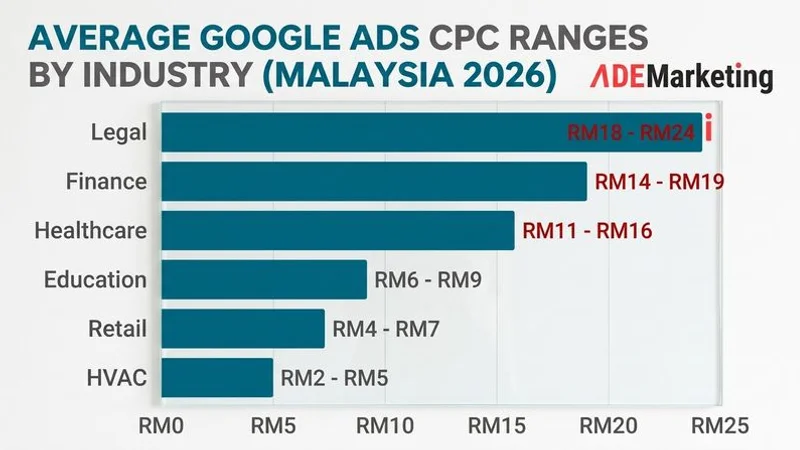
Cost-per-click (CPC) is a heavily debated metric, though it is far from the only indicator of success. The 2026 digital auction environment features less available space above the fold, pushing average costs higher across the board. We regularly track these shifts to keep our strategies aligned with reality. The current pricing landscape demands a precise understanding of industry benchmarks.
| Industry Category | Average CPC Range | Key Market Driver (2026) |
|---|---|---|
| Retail & E-commerce | RM1.50 to RM4.00 | Shopee & Lazada integration |
| Home & Auto Services | RM5.00 to RM12.00 | High-intent mobile searches |
| Legal & Financial | RM15.00 to RM50.00+ | High lifetime value (CLV) bidding |
Low CPC Industries (RM1 to RM5)
Retail and e-commerce campaigns experience intense volume. We see major platforms like Shopee and Lazada integrating directly with Google Ads, which increases the density of the auction.
- Retail and e-commerce (general products): RM1.50 to RM4
- Food and beverage: RM1 to RM3
- Travel and hospitality: RM2 to RM5
- Education (general): RM2 to RM4
Broad audiences keep these clicks relatively cheap. High traffic does not automatically equal strong returns. You must strictly monitor your conversion rates and average order values to remain profitable.
Medium CPC Industries (RM5 to RM15)
The mid-range encompasses the majority of local service businesses. Search terms with immediate buying intent, such as “aircond servicing price PJ”, quickly convert lookers into buyers.
- Healthcare and medical: RM5 to RM12
- Real estate (sub-urban): RM6 to RM15
- Automotive repair: RM5 to RM10
- Home services (plumbing, electrical, renovation): RM5 to RM12
- Professional services (general): RM5 to RM10
We recommend targeting these mid-range users with exact match phrasing first. Securing a 14 percent conversion rate, which is common in automotive repair, makes a RM8 click highly valuable. Quality score optimisation keeps your acquisition costs manageable here.
High CPC Industries (RM15 to RM50+)
High-value client acquisitions justify aggressive spending. Specific, competitive terms like “KLCC condo for rent” frequently hit RM15 per click due to fierce local bidding wars.
- Legal services: RM15 to RM40 (Global averages exceed RM40)
- Financial services: RM15 to RM35
- Insurance: RM20 to RM50
- IT and software services: RM10 to RM30
- Digital marketing and SEO services: RM15 to RM35
Our clients in the legal sector understand that a RM30 click for a case worth RM50,000 makes perfect economic sense. The profit margins dictate the bidding tolerance. You need flawless landing pages at this level to prevent expensive traffic from bouncing.
Monthly Budget Recommendations
Setting the right monthly budget requires matching your industry costs with your growth ambitions. We always start by defining a clear business goal before allocating a single Ringgit. A generic budget approach usually results in thin data and missed opportunities.
Small Local Businesses: RM1,500 to RM5,000/month
Single-location businesses targeting specific postcodes thrive in this range. You should focus exclusively on high-intent keywords that signal immediate needs.
- Prioritise exact match phrasing.
- Restrict geographic targeting to your service radius.
- Direct all traffic to a WhatsApp conversion button.
Our most successful local campaigns use WhatsApp automation to capture leads instantly. Avoiding broad match terms prevents your budget from vanishing on casual researchers.
Mid-Size Businesses: RM5,000 to RM15,000/month
Growing companies with multiple service lines require broader data collection. This budget allows you to test Performance Max (PMax) campaigns effectively.
- Allocate funds across Search and Display.
- Implement 10,000-word negative lists (the new 2026 PMax limit).
- Test different landing page variations.
We rely on these extended negative keyword limits to block irrelevant traffic across AI-driven networks. Granular control over your exclusions ensures the algorithm learns from actual buyers.
Large and Enterprise: RM15,000 to RM100,000+/month
National brands face aggressive competitors and complex auction dynamics. You must leverage automated bidding alongside rigid manual oversight.
- Segment campaigns by product margin.
- Deploy advanced cross-channel remarketing.
- Integrate CRM data for offline conversion tracking.
Our enterprise strategy involves dedicated professional SEM management to manage this advanced framework. The sheer volume of daily data requires continuous fine-tuning to maintain a competitive edge.
What Actually Drives Your Google Ads Costs
Accepting high clicks as unavoidable is a costly mistake. You can strategically lower your expenses by controlling the variables within your account.
Quality Score Mechanics
Google rewards relevant advertisers with lower prices. The Quality Score algorithm relies on three main pillars:
- Expected click-through rate
- Ad relevance
- Landing page experience
We focus heavily on tightening keyword intent to boost this score. A rating of 10 can halve your actual CPC, while a rating of 1 quadruples it.
This dynamic explains why SEO expertise enhances SEM performance. Applying core ranking principles like fast load times and clear messaging directly improves your ad efficiency.
Competitor Bidding Behaviour
Auction inflation is a harsh reality in the current market. We frequently see one or two large players artificially inflating costs through aggressive, unmonitored bidding.
A strategic response beats joining a bidding war. You can outmanoeuvre heavy spenders by finding long-tail variations they ignore.
Keyword Selection and Match Types
Relying solely on broad match casts a wide net but catches too much irrelevant traffic. Recent data shows phrase match CPCs surging by 43 percent over a two-year period.
Our process involves blending match types with rigorous exclusion tactics. Negative keyword lists act as your primary defence against budget drain. Building an industry-specific exclusion list can slash wasted spend by 30 percent almost immediately.
Ad Schedule and Device Targeting
The default setting for campaigns is to run continuously. We call this the “24/7 burn”, and it silently destroys profitability.
B2B searches during the night shift often result in zero qualified leads. Up to 20 percent of a daily budget is frequently wasted between midnight and 6 AM. You must adjust your bid schedules to target the 9 AM to 5 PM power hours.
Concentrating your budget when prospects are awake and ready to decide yields far superior results compared to continuous running.
Beyond CPC: The Metrics That Actually Matter
Obsessing over the cost of a click distracts from the actual health of your campaign. You must evaluate the metrics that tie directly to your bottom line.
Cost Per Acquisition (CPA)
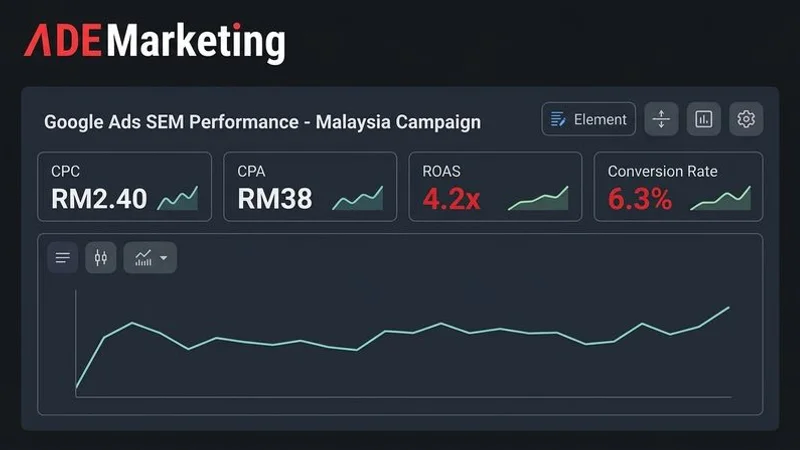
Your CPA reveals the true price of gaining a customer. This calculation factors in your click costs, your conversion rate, and your sales cycle length.
We prefer paying RM30 for a click that converts at 10 percent, yielding a RM300 CPA. Paying RM5 for cheap traffic that converts at 0.5 percent results in a RM1,000 CPA. The supposedly cheap clicks are actually punishing your profit margin.
Return on Ad Spend (ROAS)
ROAS measures the direct revenue generated by your advertising investment. We target a minimum 4:1 ROAS ratio for most local service campaigns.
- E-commerce: Target 6:1 or higher due to inventory costs.
- Lead Generation: Accept 3:1 if the lifetime value is high.
- SaaS/Subscriptions: Measure against first-year revenue.
You generate RM4 for every RM1 spent when hitting that baseline target. High-value sectors like finance can often justify a lower initial return.
Customer Lifetime Value (CLV)
Campaign ROI requires a long-term perspective. You dramatically underestimate the platform’s value if you only measure the very first transaction.
Our financial clients know that acquiring a customer for RM500 is brilliant if they generate RM50,000 over ten years. Assessing lifetime value shifts your mindset from quick sales to sustainable growth.
Common Budget-Wasting Mistakes
Reviewing hundreds of accounts reveals identical patterns of financial leakage. A massive 2026 industry study covering 15,000 accounts found the average campaign wastes over RM5,000 every single month.
We routinely fix these specific critical errors:
- Operating without conversion tracking. You are flying blind if you cannot trace a lead back to its source keyword. The system cannot optimise for buyers if it does not know what a buyer looks like.
- Sending all traffic to the homepage. Generic homepages dilute your message and kill conversion rates. You must send traffic to dedicated landing pages that directly match the search query.
- Ignoring negative keywords. The study noted above found that 25 percent of advertisers use zero negative keywords. We see their conversion rates plummet to a mere 4.6 percent as a result.
- Running set-and-forget campaigns. The platform requires weekly maintenance. You need to adjust bids, refine audiences, and test ad copy continuously to stay competitive.
- Bidding blindly on brand terms. Bidding on your own name is useful strategically, but many companies waste funds here. You should not pay for a click if you already dominate the organic results for that exact term.
The SEO-SEM Integration Advantage
At ADE Marketing, the core strategy stems from a belief that organic and paid channels amplify each other. A strong technology background allows our team to manipulate the technical factors driving both organic rankings and Quality Scores.
We use organic search data to uncover hidden, cheap keyword opportunities for paid campaigns. Paid search data, on the other hand, immediately highlights which keywords are worth the long-term organic struggle.
Connecting these channels creates distinct advantages:
- Lower acquisition costs
- Higher conversion rates
- Unified search presence
You achieve absolute authority when dominating both the paid and organic results. Integrated search visibility consistently delivers the strongest return for serious businesses.
Making Your Budget Decision
Profitable growth is the only metric that truly matters. You must start by analyzing your business economics before launching a campaign.
Calculate your absolute maximum cost per acquisition based on your profit margins. We recommend working backward from that threshold to find your ideal bid price. If the numbers align, you should invest confidently and aggressively.
If the math fails, you must fix your landing pages or explore organic search and GEO strategies as alternatives. Applying the framework from The Cost of Google Ads in Malaysia: 2026 SEM ROI Guide ensures your business targets profitable growth.