22 Years of Google Algorithm Updates: What Actually Mattered
A veteran SEO practitioner's retrospective on two decades of Google algorithm updates. Learn which changes genuinely reshaped search marketing and what patterns predict the future.

We have all felt that familiar stomach drop when website traffic vanishes overnight.
Looking back over 22 Years of Google Algorithm Updates: What Actually Mattered becomes clear when you focus on business impact rather than technical hype.
Our team started working in search marketing back in 2004.
The SEO industry treats every tweak as an emergency, but only a handful genuinely reshape how search engine optimisation works.
This retrospective covers the updates that forced real pivots and changed how operations run at ADE Marketing.
Understanding these historical patterns provides a clear roadmap for protecting your digital presence today.
22 Years of Google Algorithm Updates: What Actually Mattered
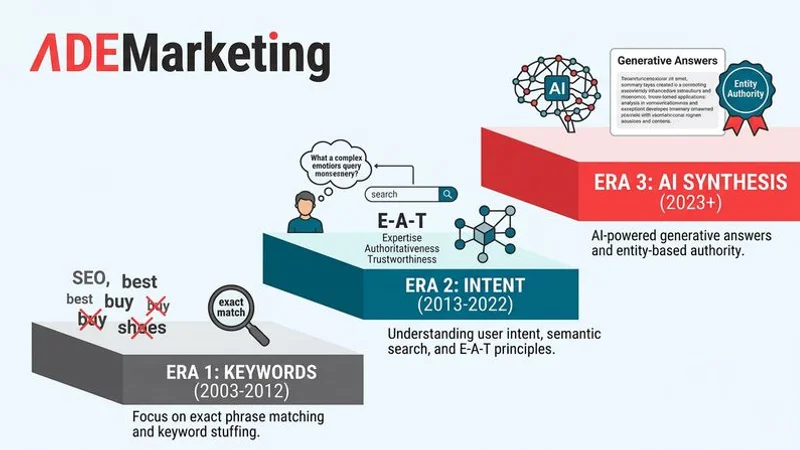
Florida (2003): The End of Keyword Stuffing
Strictly speaking, this predates the founding of our agency by a year, but its effects defined the early landscape.
Florida served as the first major crackdown on keyword manipulation. Before this point, ranking involved cramming phrases into hidden text and doorway pages.
Many early e-commerce retailers saw up to 90 percent of their organic traffic vanish overnight.
- The core lesson: Google was serious about quality.
- The business impact: Shortcuts offer diminishing returns over time.
Panda (2011): Content Quality Becomes a Ranking Factor
Panda was transformative for the internet at large. For the first time, algorithmic assessments of content quality happened at scale.
We watched as content farms and thin affiliate sites were systematically demoted.
Google confirmed this initial rollout impacted nearly 11.8 percent of all search queries globally.
”Content quality is measurable by algorithms, not just human reviewers.”
Sites focusing on substantive, original material stayed safe, while competitors relying on volume suffered dramatically.
Penguin (2012): The Link Manipulation Reckoning
If Panda addressed content quality, Penguin completely upended the link-building industry. Paid links and manipulative anchor text schemes faced aggressive penalties.
We vividly remember the chaotic aftermath of this rollout. Clients buying link packages from dubious providers watched their lead generation collapse instantly.
The recovery process proved brutal and exhausting.
- The Disavow Tool: Google introduced this feature in October 2012 to help webmasters renounce toxic backlinks.
- Recovery Timeline: Rebuilding a natural link profile often took six months or longer.
- The Takeaway: There are no sustainable shortcuts to domain authority.
Hummingbird (2013): Understanding Intent, Not Just Words
Hummingbird operated more quietly than previous updates, yet it proved vital for long-term strategy. It represented a massive shift from matching exact phrases to understanding query intent.
Our approach to content strategy shifted directly because of this conversational search focus.
Recent statistics from 2025 show that voice search adoption in Malaysia continues to climb, proving that semantic understanding remains foundational.
”Optimise for broad topics and user intent instead of targeting individual, isolated keywords.”

RankBrain (2015): Machine Learning Enters Search
RankBrain marked the first confirmed use of machine learning in the core ranking algorithm. It successfully handled queries that had never been searched before.
We learned that this system managed approximately 15 percent of daily searches at the time.
Google executives later named it the third most important ranking factor in their system.
- Pattern recognition: The system excels at finding relationships between seemingly unrelated words.
- Continuous learning: The gap between what you write and what the algorithm understands narrows every single day.
Mobile-First Indexing (2018-2021): The Desktop Web Becomes Secondary
This gradual transition felt less dramatic than a single day penalty, but it heavily influenced web development. Sites offering poor smartphone experiences saw significant visibility declines.
Our local clients were well-positioned because the team had been building mobile-first designs for years.
By 2023, the smartphone penetration rate in Malaysia had reached 89 percent, with continuous growth expected through 2026.
| Strategy Area | Desktop-Era Approach | Mobile-First Requirement |
|---|---|---|
| Navigation | Complex drop-down menus | Touch-friendly thumb targets |
| Media | Large, high-resolution images | Compressed, responsive visuals |
| Reading | Dense blocks of text | Short paragraphs for small screens |
Core Web Vitals (2021): Performance as a Ranking Signal
The introduction of Core Web Vitals officially incorporated user experience metrics into the ranking evaluation.
Page speed, visual stability, and interactivity became quantifiable factors.
We immediately recognised that basic technical performance was no longer optional for serious businesses.
”Technical performance dictates visibility, reinforcing our conviction that technology expertise is essential for effective search marketing.”
This landscape shifted again in March 2024 when Interaction to Next Paint (INP) replaced First Input Delay (FID). Websites now need a response latency of less than 200 milliseconds to pass this new responsiveness check.
Helpful Content System (2022-2024): The AI Content Reckoning
These updates arrived as a direct response to the massive explosion of automated, low-quality publishing. Site-wide classifiers began identifying domains publishing material purely to manipulate rankings.
Our audits revealed devastating impacts for publishers prioritising volume over genuine expertise.
In March 2024, Google incorporated these helpfulness signals directly into the core algorithm.
- The Target: The March 2024 core update aimed for a 40 percent reduction in unhelpful, unoriginal material.
- The Penalty: Entire domains face demotion if a significant portion of their pages lack real substance.
- The Solution: Demonstrable E-E-A-T signals must be consistent across every single page.
AI Overviews (2024-2026): The Search Interface Revolution
The integration of AI-generated answers directly into results represents the biggest interface change since featured snippets.
For many queries, traditional blue links now sit below a synthesized summary.
We watched this shift drive the emergence of generative engine optimisation as a mandatory discipline.
”The search interface itself acts as a variable today. Ranking number one means something completely different when an AI summary pushes your link below the fold.”
A December 2025 Ahrefs study found that these overviews reduce the organic click-through rate for position-one content by 58 percent. Being cited within these AI summaries requires entirely different formatting than ranking in standard organic results.
Patterns That Predict the Future
Quality Requirements Only Increase
Every major algorithmic shift raises the minimum bar for technical quality and user experience. The search engine has never lowered its standards over the past two decades.
Our recommendation is to invest in the highest quality production your budget allows.
Anything built on shortcuts eventually faces penalisation.
- Content depth: Surface-level articles no longer compete.
- Technical speed: Milliseconds of delay cost you rankings.
- Backlink profile: Natural authority always beats artificial metrics.
Google Follows User Behaviour
Mobile-first indexing happened because consumers adopted smartphones en masse. AI Overviews followed the explosive mainstream adoption of artificial intelligence assistants.
We closely monitor how people actually interact with digital tools rather than listening to industry speculation.
In Malaysia, aggressive digital adoption proves that AI-assisted research is a permanent shift.
”GEO preparation is not a speculative bet; it represents a direct response to confirmed changes in consumer research habits.”
Automation of Quality Assessment Improves Continuously
The transition from Panda’s early filters to the modern site-wide classifiers shows massive leaps in automated evaluation. The algorithms evaluate authenticity with increasing precision every single year.
Our internal testing proves that manipulative tactics escaping detection today will face penalties tomorrow.
Build for lasting structural integrity rather than exploiting temporary blind spots.
- Machine learning: Systems like RankBrain continuously adapt to new spam tactics.
- Holistic evaluation: Entire domains are judged based on their weakest pages.
Recovery Is Always More Expensive Than Prevention
Every business owner who comes to the agency after an algorithmic penalty ends up spending more on cleanup than proper strategy would have cost. The financial drain of lost leads is staggering.
We have seen companies lose thousands of dollars in revenue while waiting six months for a disavow file to process.
Doing the job correctly from day one serves as the best insurance policy for your digital assets.
| Investment Type | Cost Implication | Business Disruption |
|---|---|---|
| Proactive SEO | Predictable monthly budget | None (continuous growth) |
| Penalty Recovery | High emergency consulting fees | Severe (months of lost traffic) |
What This Means for 2026 and Beyond
The convergence of traditional search and AI-powered discovery stands as the defining trend of this current era. Businesses positioned for the next five years must build topical authority while preparing for AI citations as a primary traffic channel.
Our longevity in this field proves the value of extreme adaptability.
Survival through every algorithm shift requires adhering to a simple principle: build genuine value for the human reading the page. That principle remains solid through 22 years of changes, and it will protect your property business through whatever comes next.
The companies that thrive during these rollouts never build their foundation on exploiting temporary weaknesses. Invest heavily in substance, build on solid technical foundations, and integrate your paid search strategy with clear intentions.
Treating 22 Years of Google Algorithm Updates: What Actually Mattered as a learning tool turns future updates into pure opportunity. Contact the advisory team today to audit your current vulnerability and secure your search visibility for the coming year.