SEO vs GEO: Where Should Malaysian Businesses Invest in 2026?
A practical comparison of traditional SEO and Generative Engine Optimisation for Malaysian businesses. Learn which strategy deserves your budget in 2026 based on 22 years of search marketing experience.
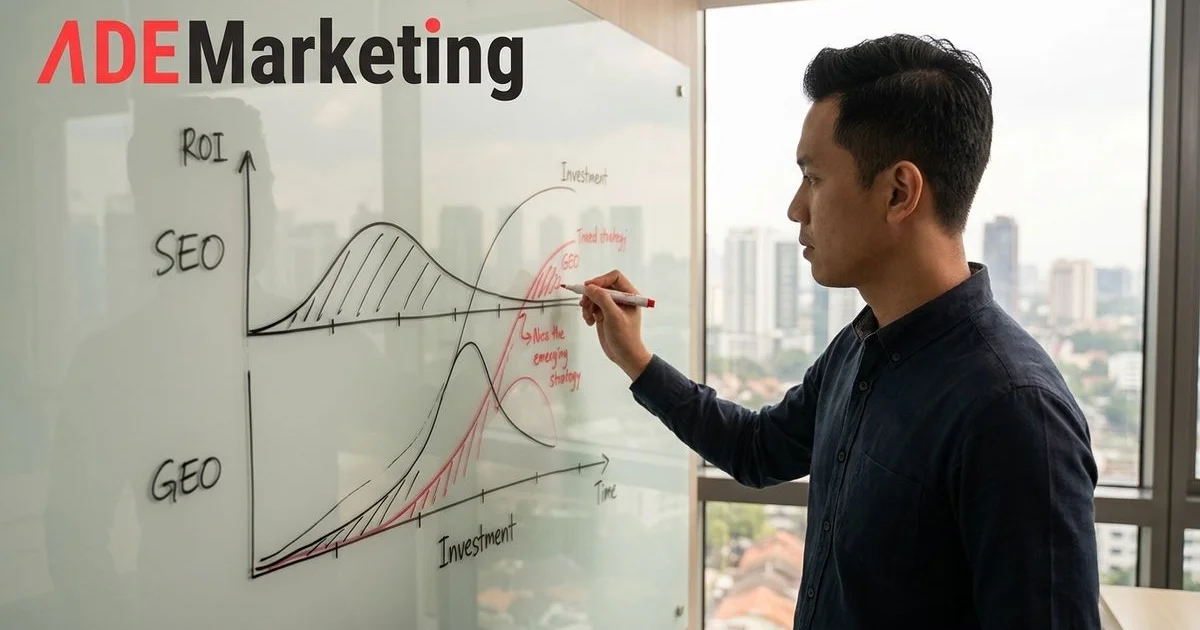
The question we hear most frequently from business owners is deceptively simple.
SEO vs GEO: Where Should Malaysian Businesses Invest in 2026?
Our team has spent more than two decades building search visibility across Southeast Asia at ADE Marketing. The industry often treats these disciplines as competing budget items.
We have learned that this is a fundamentally flawed approach. Businesses achieving the strongest results understand that traditional search and generative engine optimisation are actually complementary forces.
Our goal today is to break down the core differences and review the latest Malaysian search data. Let us explore exactly how you can allocate your marketing budget for maximum impact this year.
Understanding the Core Difference
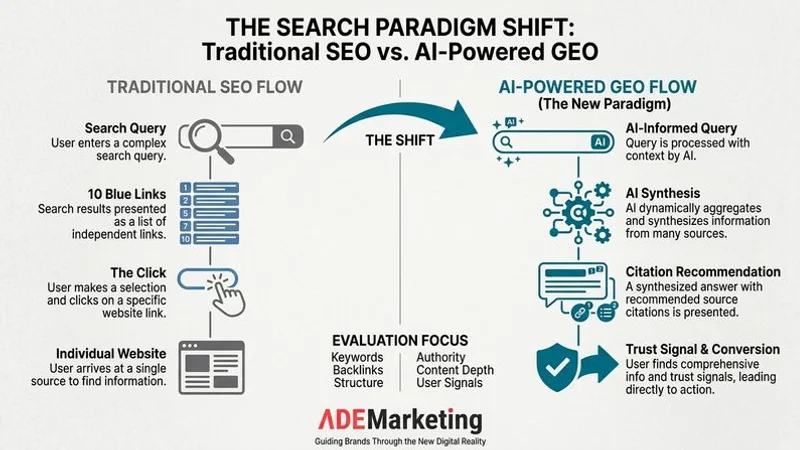
Traditional search engine optimisation focuses on ranking your website within the familiar blue-link results on Google, Bing, and other conventional search engines. You optimise page titles, build authoritative backlinks, and ensure technical health to match user intent. The goal is straightforward because you want to appear as high as possible on the search engine results page for queries relevant to your business.
Generative engine optimisation, by contrast, concerns itself with how your brand surfaces within AI-generated answers. When a potential customer asks a chatbot a question about your industry, GEO determines whether your business gets cited in the response.
We must pay attention to this distinction because user behaviour is rapidly shifting. Recent 2025 marketing reports reveal that nearly 48.4 percent of Malaysian internet users now actively engage with ChatGPT. This platform currently holds a commanding 80 percent share of the AI chatbot market in Malaysia, while tools like Google Gemini follow with roughly 10 percent.
Malaysian internet users are clearly comfortable asking AI assistants for recommendations, comparisons, and advice.
| Feature | Traditional SEO | Generative Engine Optimisation (GEO) |
|---|---|---|
| Primary Target | Search engines (Google, Bing) | AI Chatbots (ChatGPT, Gemini, Perplexity) |
| User Intent | Finding specific websites or pages | Seeking direct answers or summaries |
| Key Tactics | Backlinks, keywords, technical health | Entity relationships, clear citations, schema |
| Result Format | Ranked blue links | Conversational text with inline citations |
Where SEO Still Dominates
Let me be direct about the current landscape. SEO is certainly not dying.
Our analysis shows that Google still holds a massive 93.4 percent search engine market share in Malaysia as of early 2026. Anyone telling you traditional search is obsolete has not examined the data carefully enough.
Here is where traditional organic strategies remain the strongest investment for your business.
Transactional Intent Queries
When someone searches “best air conditioning installer near me” or “accounting firm Petaling Jaya,” they are ready to act. These transactional queries still overwhelmingly drive users to traditional search results and business websites.
We see strong click-through rates from organic search for these high-intent local queries. Local business owners consistently note on forums that Google Maps drives the vast majority of their foot traffic, as AI tools sometimes hallucinate specific operating hours or locations.
E-Commerce and Product Discovery
Malaysian e-commerce continues to grow rapidly. Product-specific searches like pricing comparisons and availability checks still funnel through traditional channels.
Our team knows that mobile devices now account for a staggering 71 percent of all Google searches. This mobile dominance is where impulsive e-commerce clicks happen. If you are selling products online, your SEM strategy combined with organic SEO is absolutely your primary revenue driver.
Local Service Businesses
For plumbers, dentists, and lawyers in Malaysia, local SEO remains the most cost-effective customer acquisition channel. AI search assistants have improved at broad recommendations, but they still lack the pinpoint accuracy of Google Business Profile listings.
You simply cannot beat the reliability of a well-optimised Google Maps presence for “near me” searches. The live reviews, exact GPS coordinates, and updated photos provide a level of immediate trust that a chatbot summary cannot match.
Where GEO Is Becoming Essential
The digital landscape is shifting rapidly. There are clear areas where GEO investment is already paying massive dividends.
Brand Authority and Trust Building
When a potential client asks ChatGPT “What are the best SEO agencies in Malaysia?” the businesses that appear gain enormous credibility. This is brand positioning at scale, and it is increasingly difficult to achieve through traditional SEO alone.
We must acknowledge that nearly 60 percent of Google searches now result in zero clicks, meaning users get their answers directly on the results page or via AI summaries. If your brand is not mentioned in those direct answers, you are entirely invisible to a huge portion of the market.
Research-Phase Influence
Before making significant purchasing decisions, Malaysian consumers use AI assistants to conduct preliminary research. They ask complex questions to figure out what they should look for in a service provider.
Our industry peers on platforms like Reddit frequently mention bypassing traditional Google results to ask tools like Claude for unbiased agency reviews. If your expertise is cited in these AI responses, you influence the buyer long before they ever visit a traditional search engine.
Thought Leadership in B2B
For B2B companies and professional services firms, GEO is rapidly becoming the primary differentiator. Corporate decision-makers use AI tools extensively to research potential vendors.
We find this especially true considering that 58 percent of B2B search queries still happen on desktop computers. These desktop users frequently keep a conversational AI tab open as a dedicated research assistant. Being cited as an authority in those specific AI outputs carries significant weight for your sales pipeline.
The Real Answer: An Integrated Approach
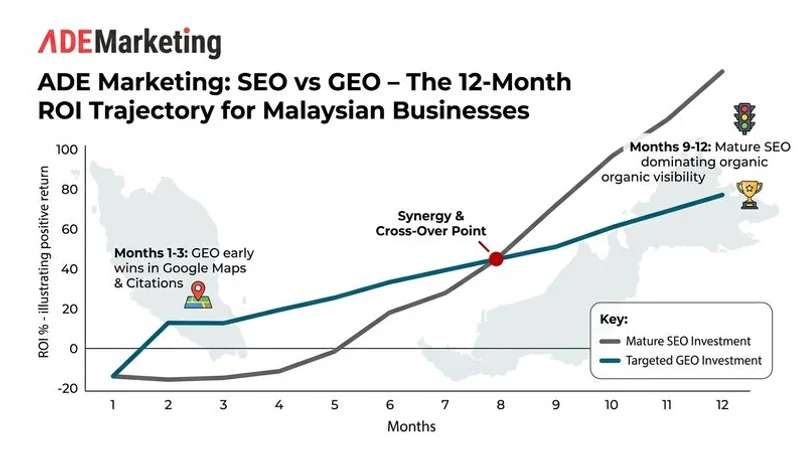
After 22 years in this industry, our team has seen enough extreme debates to know they rarely reflect reality. The businesses winning in 2026 are investing in both channels with strategic allocation.
Our Recommended Budget Split for Malaysian SMEs
For most Malaysian small and medium enterprises, we recommend starting with a straightforward 70/30 split. You should allocate 70 percent of your search marketing budget to SEO, including technical health and local optimisation.
Our strategy dedicates the remaining 30 percent specifically to GEO readiness. This targeted GEO allocation should focus on several key pillars:
- Structured content creation: Formats that AI systems can easily parse, such as clear Q&A sections.
- Entity optimisation: Establishing your brand across knowledge graphs and trusted databases.
- Citation building: Publishing on platforms that AI models actively reference during their training cycles.
- Technical implementation: Using tools like Schema.org markup and llms.txt files to provide clear AI-readability signals.
Larger enterprises with established SEO foundations should consider shifting to a 50/50 allocation. The marginal returns from additional SEO investment eventually plateau, while fresh GEO opportunities remain largely untapped.
What Our Data Shows
At ADE Marketing, we have been tracking AI citation rates for our clients since early 2025. The results are incredibly telling for the Malaysian market.
Clients who invested in GEO preparation alongside their SEO programmes saw an average 34 percent increase in brand mentions across AI platforms within six months. These mentions directly correlated with a measurable uptick in website traffic and branded search queries.
We also noticed a fascinating trend in content structure. Websites featuring highly structured, SEO-optimised blogs receive up to 50 percent more average monthly traffic from AI search platforms compared to sites with unstructured content. AI citations are clearly driving real, measurable discovery.
Why Technology Matters in This Decision
One significant advantage our firm brings to this conversation is a unique dual perspective.
We operate as both a search marketing agency and a dedicated technology builder. Development teams inside our company have built four SaaS products, including Agility Writer and LocusPilot.
This hands-on experience means our staff understands the intricate technical infrastructure required for both SEO and GEO. GEO is fundamentally a technology challenge as much as a content challenge.
Many businesses fail because they attempt to use outdated keyword stuffing tactics for AI platforms, completely ignoring the structured data that large language models actually crave.
We know that optimising for AI citations demands deep structured data implementation and entity relationship mapping. Proper Schema.org implementation, for instance, can increase click-through rates from enhanced rich snippets by up to 30 percent.
This structured data is exactly what AI models require when evaluating and selecting information sources.
Practical Steps for Malaysian Businesses
If you are trying to decide where to allocate your budget today, you need a clear action plan. Here is my practical advice for moving forward:
- Audit your current SEO foundation: If your technical SEO is weak, fix that first. GEO builds on solid fundamentals, rather than replacing them.
- Assess your AI visibility: Search for your brand in ChatGPT, Gemini, and Perplexity. You have an immediate GEO gap if your business is invisible.
- Start with content architecture: Restructure your existing content to feature clear definitions and authoritative sourcing.
- Track both channels with precision: Use established tools like Ahrefs or SEMrush for traditional rankings, while implementing custom tracking for AI-driven referral traffic.
- Monitor the CTR drop: Pay attention to how AI overviews might be reducing your traditional click-through rates, as some studies show drops of up to 47 percent for basic queries.
- Consider your competitive landscape: Waiting puts you at a compounding disadvantage if your competitors are already securing AI citations.
The Bottom Line
The SEO versus GEO debate is a false dichotomy that distracts from real growth. Malaysian businesses that thrive in 2026 will integrate both strategies under a unified search visibility framework.
Our industry experience shows that ignoring either channel entirely is a massive strategic mistake. Your specific budget allocation should depend entirely on your current digital maturity and competitive landscape.
The future of search is not a choice between traditional rankings and AI citations; it is the intelligent integration of both.
We guide companies through this shifting environment with the depth of knowledge that comes from 22 years of adapting to search updates. Whether you are strengthening your SEO foundation, exploring generative engine optimisation, or refining your SEM campaigns, you must start with a strategy built on data.
Reach out to our team today to audit your current search visibility and start capturing your share of the AI market.